Writing up an inspection round takes days.
Watch it take seconds.
Photograph a device and the engine returns a structured compliance verdict: pass, fail or re-inspect, measured against the specific code section that applies in that jurisdiction, with every finding graded by severity. Your engineer still reviews and signs off; the grind of looking, deciding and writing it up simply disappears.
// What makes this different
This isn't a digital checklist.
It's a verdict.
Most inspection software still asks a person to look at equipment, judge it, and type the result, it just makes the typing faster. AI Field Auditor does the judgment itself: a photo goes in, and a structured compliance verdict: pass, fail, or re-inspect, with the specific code section it's measured against, comes out in seconds. Your engineer still reviews and signs off; the grind of looking, deciding, and writing it up simply disappears.
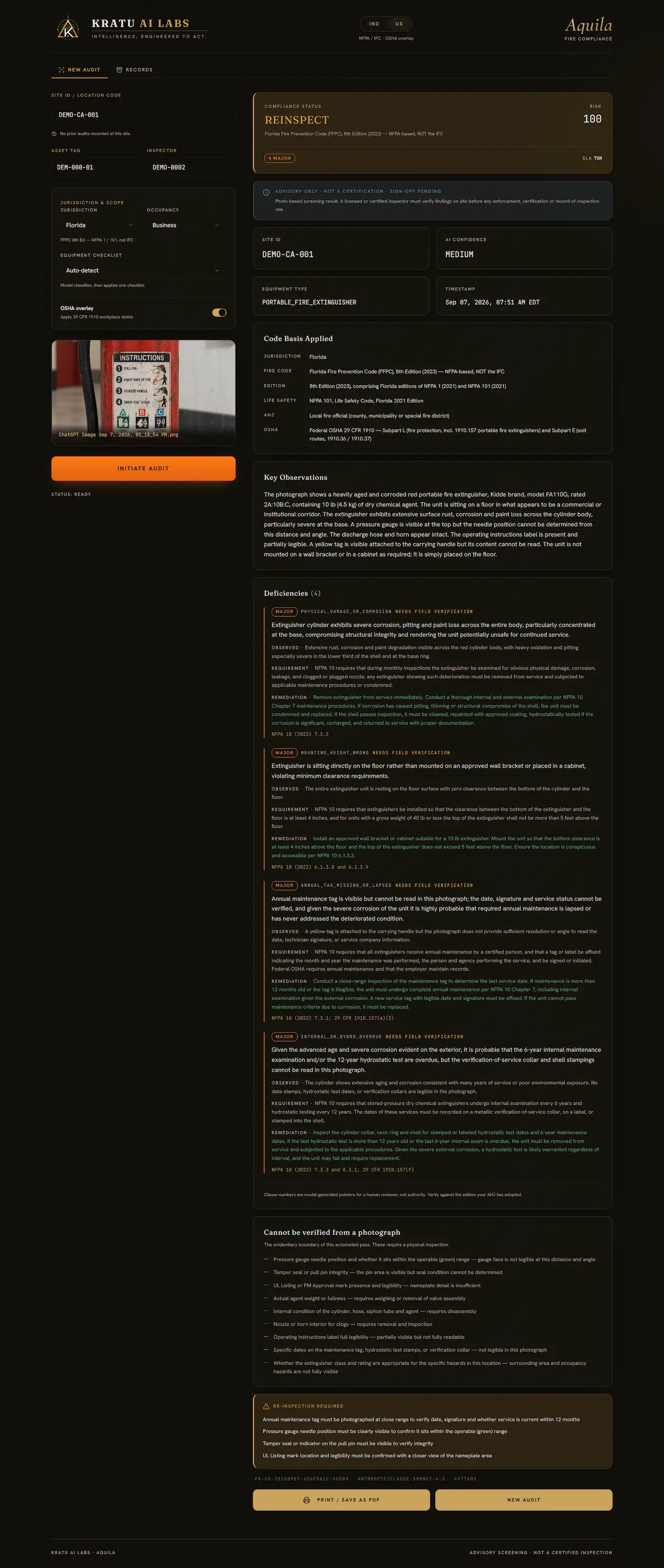
Real output. Including one it refused to pass.
Not a mockup. These are the actual artifacts from real test audits. The first is a COMPLIANT verdict with its risk score and the code basis it was measured against. The third is the one worth looking at hardest: a RE-INSPECT with major deficiencies flagged, because a screening tool that only ever agrees with you is worth nothing.
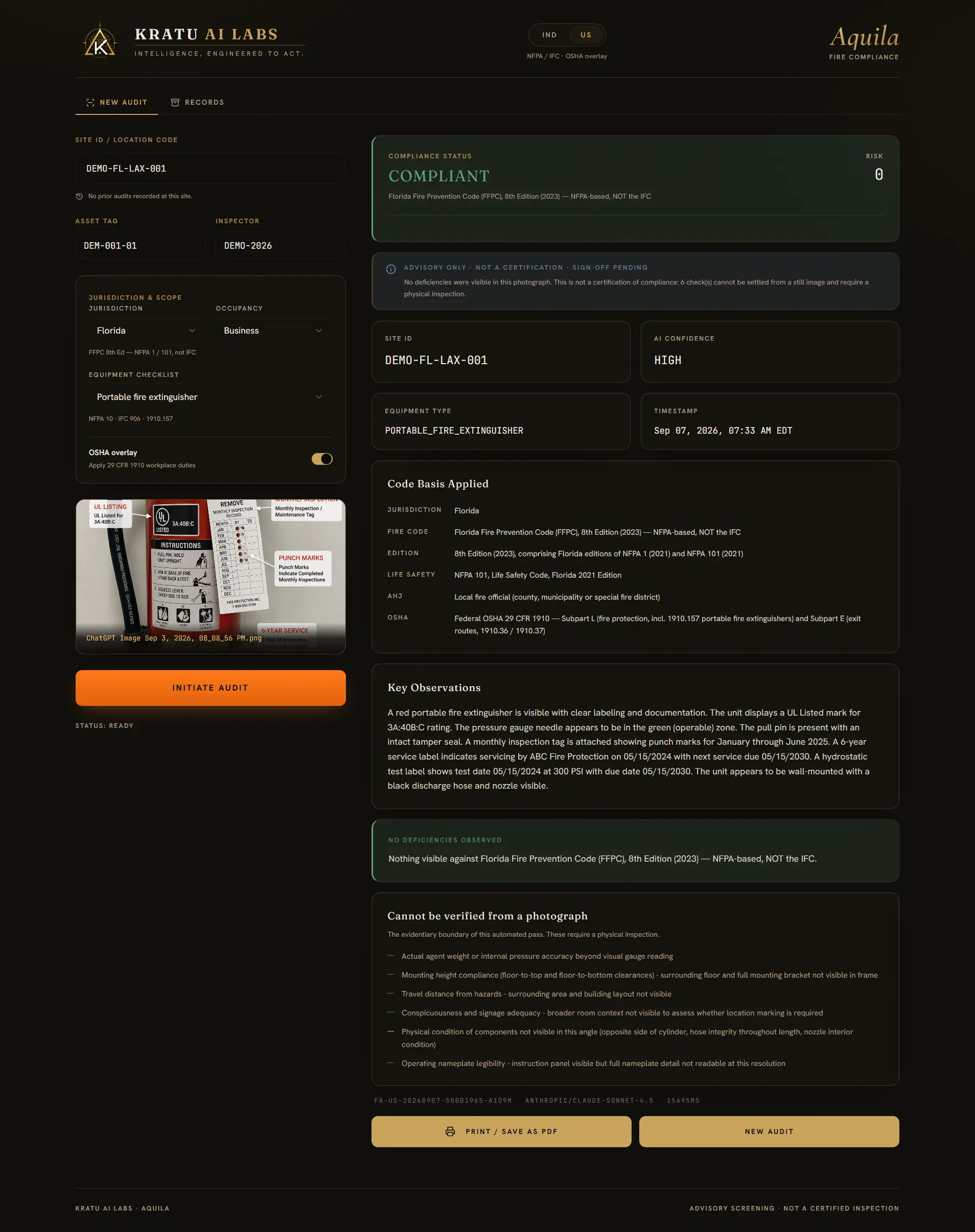
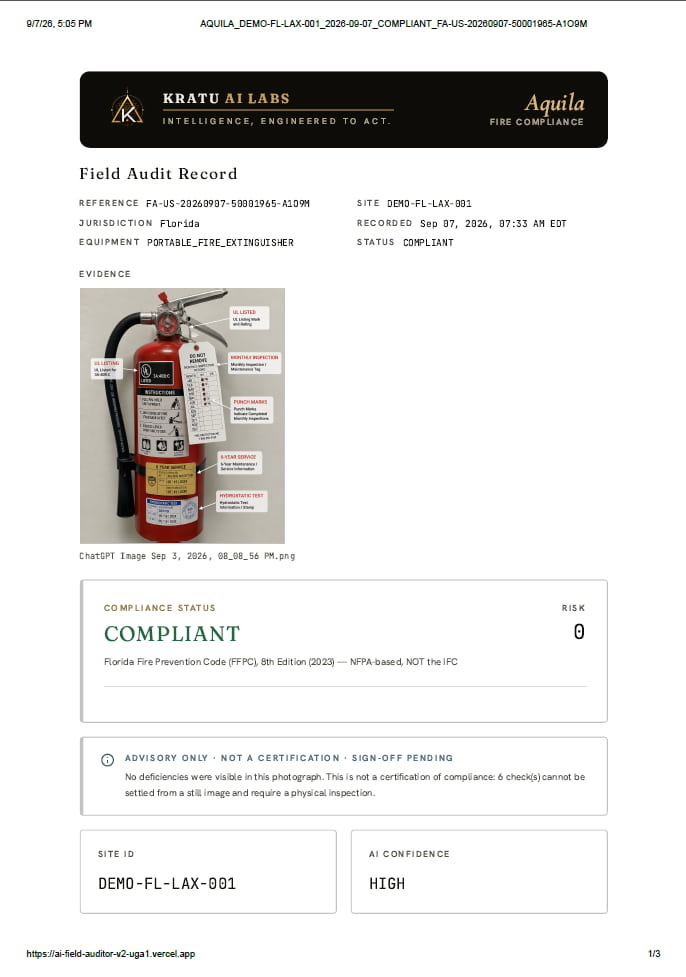
Every audit carries its own identifier, and the report is named after it, this one is FA-US-20260907-50001965-A1O9M. That is how a finding stays traceable to the exact photograph and code basis it came from, months later, in front of someone who wants to check. Site and inspector fields in this sample are demo values.
Six stages. The write-up, gone.
This is the path an inspector and a compliance reviewer walk by hand for every single device, the engine runs it end-to-end in seconds. You keep the judgement that carries professional liability; it kills the grind. Every stage stays checkable, and the internal rules and thresholds stay under the hood.
Capture & validate
A technician photographs the device on a phone. The image, the site and the asset are validated before a single cent is spent, a bad submission is refused with a reason, not silently priced.
Resolve the code basis
The jurisdiction decides which code actually governs: IFC 2024, NFPA 1 / 101, a state amendment or a city fire code, with the OSHA 29 CFR 1910 workplace overlay applied where it bites. Resolved per request, not hardcoded.
Read the equipment
Equipment class and condition are read straight off the photograph: obstruction and clearance, gauge state, tamper seal, signage, physical damage, access. What an inspector looks for, looked for consistently.
Grade every finding
Each deficiency is tiered critical / major / minor and tied to the code section it fails, so a blocked exit and a faded label are never filed as the same problem.
Derive the verdict in code
Pass, fail or re-inspect is computed from the graded findings, not asked of the model. That is the difference between a system you can defend and a chatbot with an opinion, and it is why the same photo cannot yield two verdicts.
Record, alert & sign off
The audit lands in an append-only log with its evidence photo. A critical finding alerts an operator immediately. Your engineer reviews and signs, professional accountability stays exactly where it belongs: with a human.
Re-inspect is a real answer, not a failure.
When a photograph genuinely cannot support a judgement, a gauge face too dark to read, a label out of frame, a device half behind stock, the engine returns re-inspect and says which item it could not verify. It does not quietly grade the things it could see and call the device compliant. A false pass on a fire door is the one outcome this system is built never to produce.
Scope-honest by design: every audit is marked advisory screening, it names the code basis it applied, and it flags what it could not verify rather than filling the gap. What your engineer signs off is a documented judgement, not a black-box guess. That's the difference between a demo toy and a system you can put in front of an AHJ.
The payback math, on your numbers
Let us be precise about what this does and does not replace. It does not remove your inspector, and it does not remove the qualified person who signs off. What it removes is the report production between them: the transcription, the code look-up, the grading and the rework that turn a morning's walk into a defensible file. That is the hour count you get back, and the consistency you can defend.
The building takes a morning. The defensible file takes longer, transcribing findings, hunting the right code section, grading each one, formatting it for sign-off. Licensed people doing clerical work.
The deficiency is seen on Monday and written up on Thursday. A critical fault sits in a notebook while the paperwork catches up.
Grading by hand drifts between people and between weeks, and inconsistency is exactly what an AHJ challenge attacks.
Photo to graded verdict in seconds, filed with its evidence. The critical finding alerts an operator before the technician has left the floor.
The same qualified person still reads every finding and still signs off, but reviewing a drafted, code-cited verdict takes minutes where writing one took hours. That is how one reviewer covers a portfolio instead of a building.
Grading is derived in code from the findings, so it does not drift between inspectors, sites or quarters. Consistency is the defensible part.
The only figure we assume below is the ~15 minutes it takes to read and approve a drafted, code-cited verdict. The rest is yours: find your own write-up time on the left, and swap in your own monthly volume.
| If your write-up takes today… | You get back, per report | Per 40 reports filed |
|---|---|---|
| 1 hour | ~45 minutes | ~30 hours |
| 2 hours | ~1¾ hours | ~70 hours |
| 3 hours | ~2¾ hours | ~110 hours |
We stop at hours on purpose. What an hour of your capacity is worth, absorbed internally or rebilled as field work, is your figure, not ours. Bring it to the call with your real write-up time and volume, and we will run the payback against your actual numbers instead of our assumptions.
The hour count is the easy part to model. The reason firms keep it is usually the other half: every verdict is derived in code and cites the section it fails, so the same photograph produces the same grade in December as it did in June, across inspectors, sites and quarters. Hand grading drifts, and drift is precisely what an AHJ challenge, an insurer query or a disputed finding attacks.
When that challenge comes, the answer is a record rather than a recollection: an append-only log, the evidence photograph retained against the finding, the code section quoted, the timestamp, and the name of the qualified person who approved it. That is not a cost saving we can put in a table, but it is the part that survives a deposition, and the reason consistency is worth more than speed.
Pricing below is specific to the AI Field Auditor only, other systems are scoped separately.
| Engagement | Best for | Investment |
|---|---|---|
| Launch Pilot | Prove it on your own sites first, full setup and configuration against your real equipment and your jurisdiction. One-time offer per business. | $3,500 one-time |
| Managed Subscription see plans & volumes → | We host, run and keep improving it, you prefer OpEx to owning, and want to start small and grow. | Starter $999 / month 500 audits / month Pro $1,999 / month 1,000 audits / month |
| Build & Own It licensed practice? see the partner track → | Own it outright on your own infrastructure, far cheaper over its life, and the records never leave your estate. | $45,000 one-time special introductory offer, |
Run the numbers: at $1,999/month, a managed engine passes the $45,000 one-time at about 23 months, and a firm that inspects for many years keeps paying. At the introductory price, owning it outright is dramatically cheaper over its lifetime. Start with the pilot; move to whichever model fits once you have seen it run on your own equipment.
Consultants, engineers of record and third-party ITM practices run this differently, white-labelled under their own stamp, on their own infrastructure, with their branding on the report and their name on the approval. The fact that the engine cannot certify and always needs a qualified sign-off is not a limitation in that model; it is the reason it works. See the partner track →
- It produces advisory compliance screening; a qualified person still reviews and signs off. It removes the grind, not the professional accountability, and it is not a certification.
- Accuracy tracks evidence quality. A clear, well-framed photograph yields the best result, and when the evidence will not support a judgement it returns re-inspect rather than guessing.
- Built to IFC 2024 / NFPA / USD with an OSHA 29 CFR 1910 overlay. (An NBC 2016 build for the Indian market is separate.)
See it judge your equipment.
The fastest way to believe "photo to verdict" is to watch one of your own devices become a graded, code-cited verdict in front of you, we'll hand you the report on the call.