A fire estimate takes weeks by hand.
Watch it take minutes.
Upload a fire-protection drawing and the engine returns a priced, IBC / NFPA 13 itemized estimate, on your own rate card, exported bid-ready as Excel + PDF. Your engineer still reviews and signs off; the weeks of grind simply disappear.
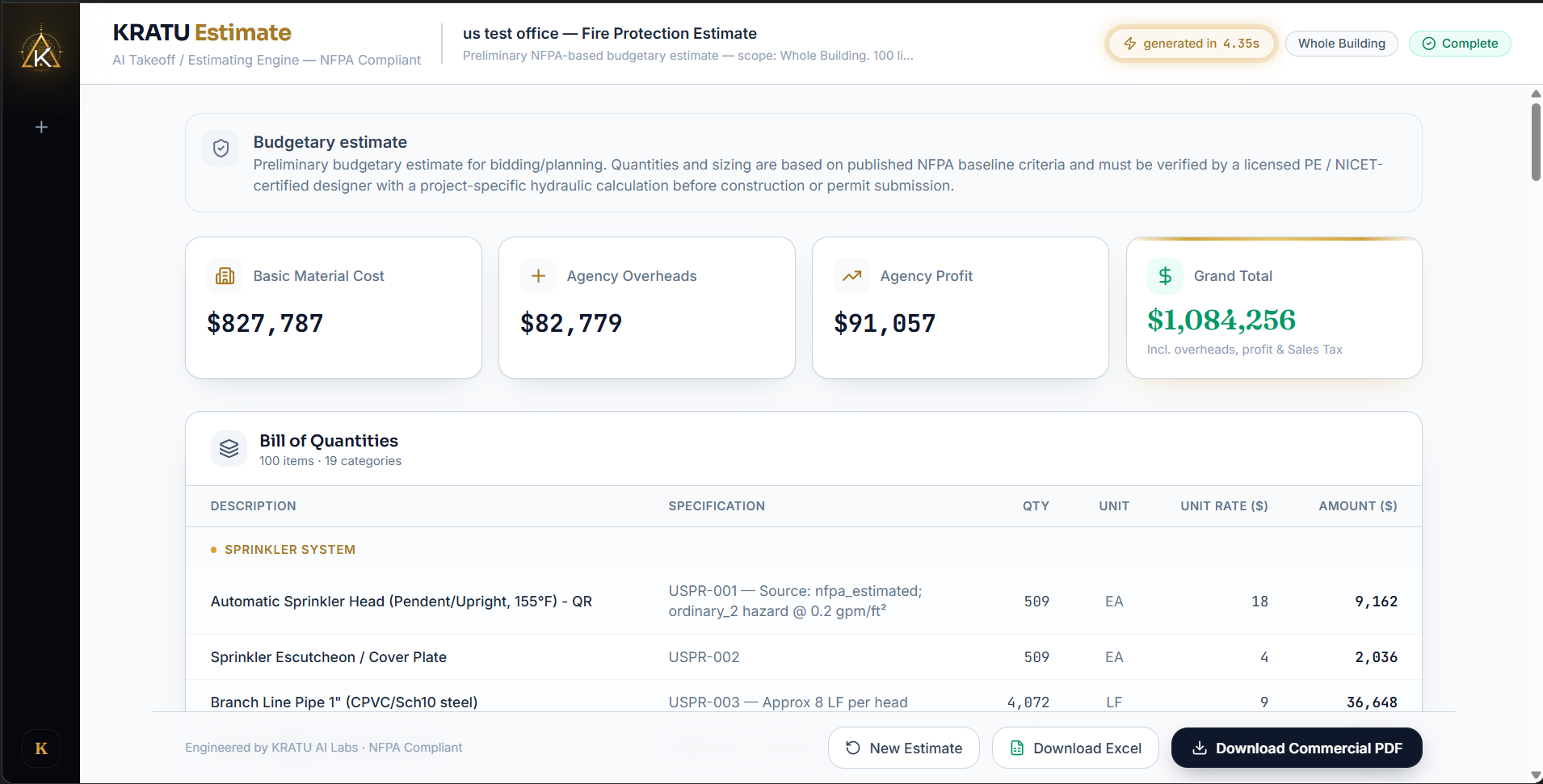
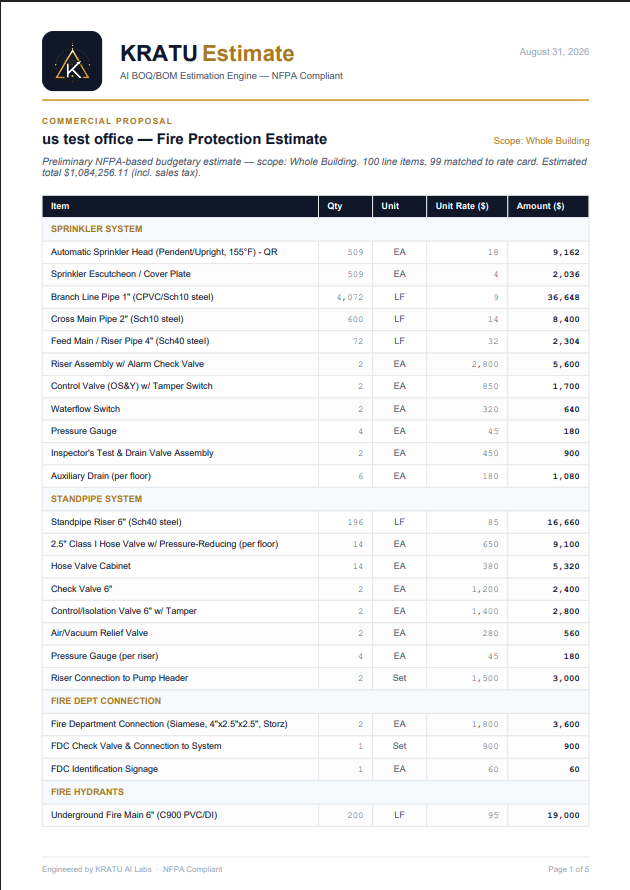
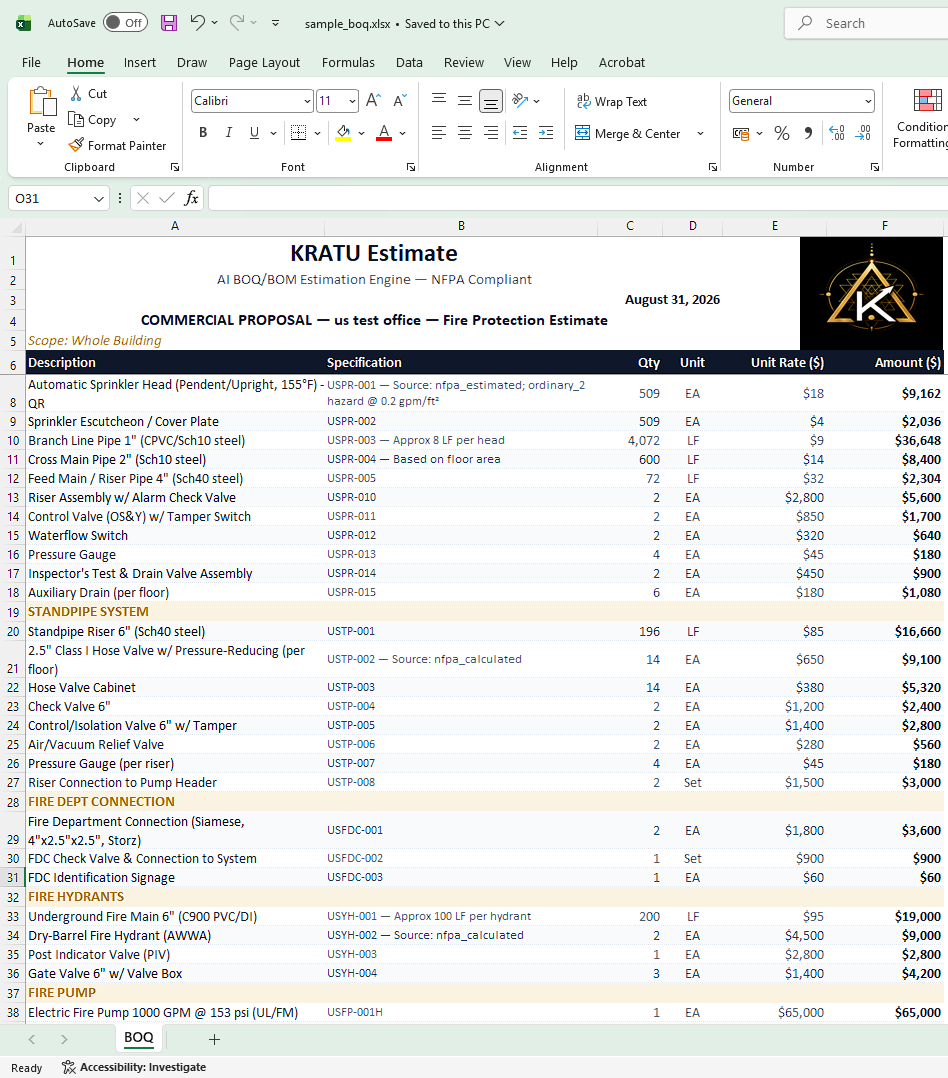
Real output. Open it yourself.
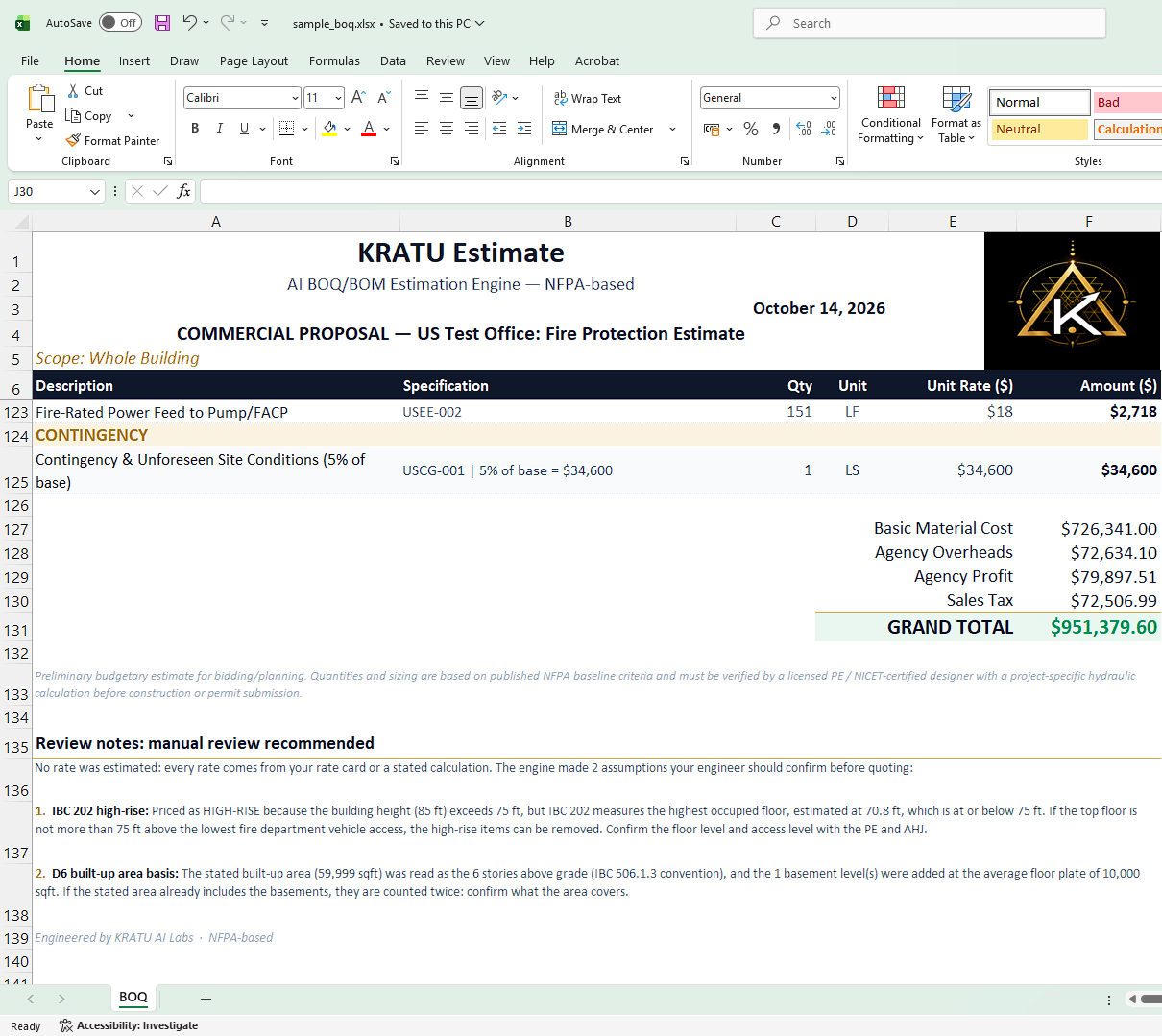
Not a mockup. These are the actual artifacts the engine produced from our reference test drawing: the live dashboard result, and the bid-ready PDF and Excel, every line and every review note included. Open the full files and inspect them, then book a demo to see the same on your own drawing.
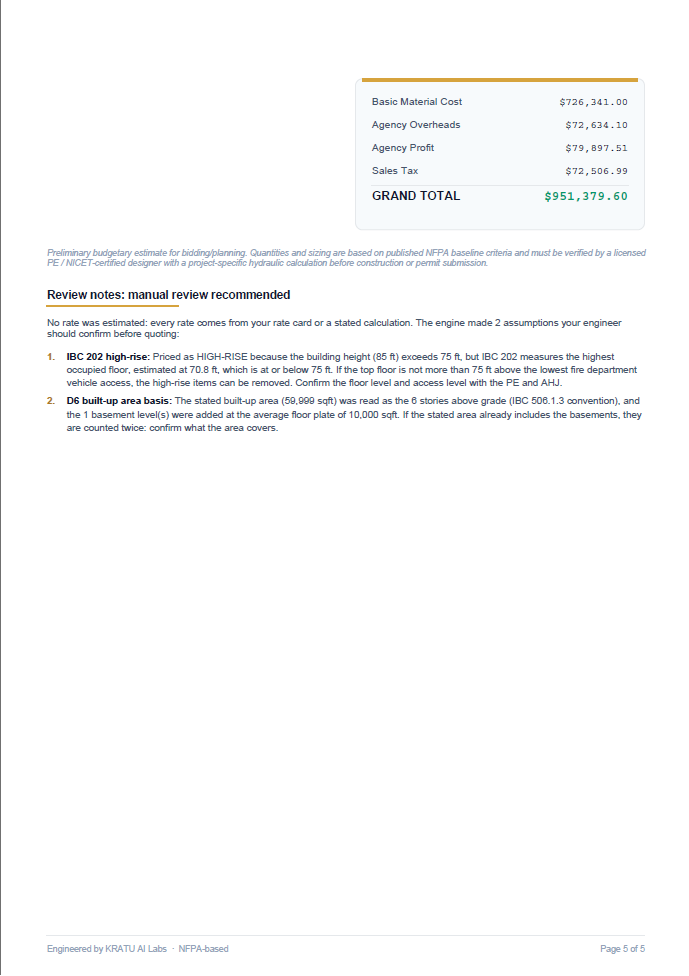
The review notes, in both files
Every assumption the engine made on this drawing, in its own words, so your engineer knows exactly what to confirm before the bid goes out. Here: the high-rise call, and how the stated built-up area was read with the basement.
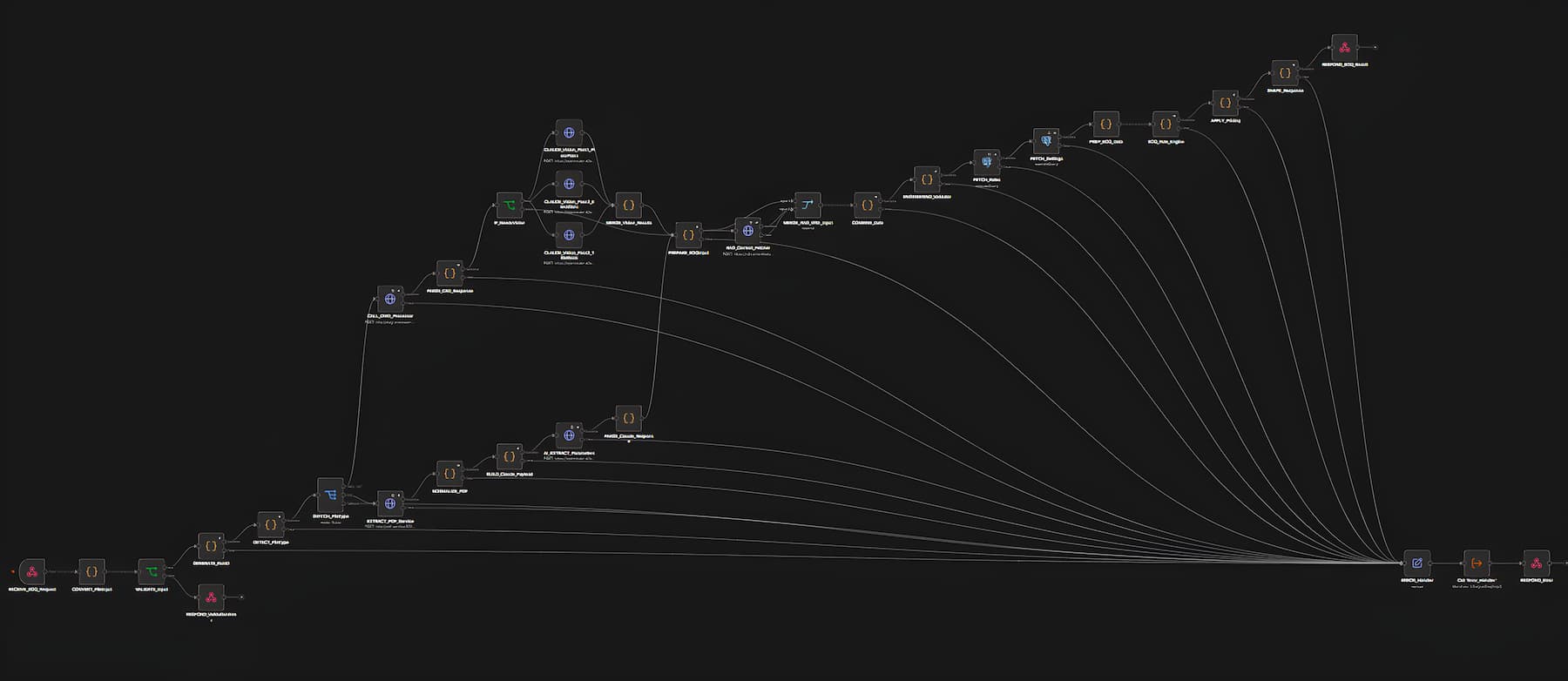
Six stages. Weeks of grind, gone.
This is the exact path your estimator walks by hand over 3–6 weeks, the engine runs it end-to-end in minutes. You keep the judgement; it kills the grind. Every stage stays checkable, and the internal rules and thresholds stay under the hood.
Ingest & normalize
CAD drawings. DWG or DXF, are converted into clean vector geometry the engine can reason over. A drawing that arrives as a PDF is rendered and read visually instead, so a PDF is no longer a dead end. No manual redrawing either way.
Detect components
Every sprinkler, detector, pull station, hydrant, hose station and extinguisher drawn as a symbol is counted. Pipework, valves and fittings are then sized to code from those counts and the building.
Measure & take off
Counts taken off the drawing, pipe runs and quantities sized from them, in imperial. Areas are read from what the drawing states, never guessed from pixels: the takeoff that devours the most estimator-hours of any job.
Apply IBC / NFPA 13
IBC and NFPA rules applied to the takeoff: occupancy group, hazard class, sprinkler and pump demand, standpipes, fire alarm. The same way on every job; the full hydraulic calculation stays with your engineer.
Assemble & cost
Items roll up into a structured estimate, priced against your own rate card, bid-ready Excel + PDF, your brand on it.
Review & sign off
Your engineer reviews, adjusts any rate, and approves, the professional accountability stays exactly where it belongs: with a human.
No CAD drawing? A PDF works too, either kind.
A PDF reaches the engine two ways, and it handles both. When your client hands you an architectural values brief as a PDF, the engine reads it and extracts every value exactly as stated. When what you have is the drawing itself as a PDF: exported from CAD, or scanned from a print, the page is rendered and read visually, so you are not stuck waiting for a DWG that may never arrive.
The honest part: a PDF carries less than the CAD file it came from, and a poor scan carries less again. Where the sheet will not settle a dimension, the engine returns a preliminary scope flagged for review rather than inventing a number, so you can see exactly what it could and could not read. Working from an Excel values sheet instead? We'll tailor the engine to your format on request.
What it applies, by code
IBC occupancy groups (A, B, E, F, H, I, M, R, S) read from the drawing, mapped to the NFPA 13 hazard class. Floors counted the way the IBC counts them: stories above grade plane, basements separate, and every level sized, basements included. A fire alarm where IBC 907.2 requires one, from an occupant-load estimate. High-rise and standpipe tests on the building height, with a note wherever the IBC floor-level test could disagree. A building that names no occupancy is priced Ordinary Hazard and flagged, never quietly priced as the lowest class.
Every assumption is shown, not buried
Each estimate carries its review notes: an occupancy assumed, how a stated area was read, a drawn device that does not match the code requirement. It reports what was read off the drawing and what was derived, with a confidence score. And a single floor sheet cannot under-price a whole building: where the devices drawn are fewer than the floors and area stated need, the estimate is priced at the building quantity and says so, line by line.
Scope-honest by design: it flags low-confidence rates ("manual review recommended") and refuses to invent whole-building items from a partial drawing, so what your engineer signs off is trustworthy, not a black-box guess. That's the difference between a demo toy and a system you can bid real projects on.
The payback math, on your numbers
Manual estimating isn't just slow, it's revenue left on the table. Here's the honest picture, and what flips the day this engine is yours.
Drawing review → hydraulic calc → takeoff → rate analysis → drafting. Every single bid crawls.
A senior estimator clears only a handful a month, the rest you simply can't turn around in time to bid.
Your best estimator is a ceiling you cannot buy past, they can't go faster, they take leave, and if they resign the method walks out with them.
A priced, IBC / NFPA 13 estimate in minutes, about a day end-to-end once your engineer has reviewed it.
Quote every RFP that lands. Each extra estimate you can now turn around is ~$5,000+ of billing you couldn't capture before.
Your server, your rate card, your brand on the output. No per-estimate fee, no seat licenses, no vendor lock-in.
That $5,000 is deliberately conservative, standard commercial estimates bill $3.5–6K, high-occupancy (hospital / mall / data-heavy) $6–11K, specialized (data center / plant) $11–17K. Plug your own numbers in:
| If it wins you… | Extra billing / year | Payback on $70K |
|---|---|---|
| +1 extra estimate / month (ultra-conservative) | $60,000 | ~14 months |
| +2 extra estimates / month (conservative) | $120,000 | ~7 months |
| +6 extra estimates / month (turning away work today) | $360,000 | ~10 weeks |
Nobody is displaced. A good fire estimator is the hardest hire in this trade, and the engine does not replace one, it produces the first-pass priced estimate that your engineer then reviews and signs. What changes is how many bids that same judgement can reach: takeoff, rate analysis and drafting stop being the ceiling, so the bid list you could never turn around in time becomes one you can.
And unlike a hire, the method is written down. Your rate card, your assumptions and your output format live in the engine, so they stay in the business when people move on.
Pricing below is specific to the AI Estimating Engine only, other systems are scoped separately.
| Engagement | Best for | Investment |
|---|---|---|
| Launch Pilot | Prove it on your own drawings first, full setup & configuration on your real drawings. One-time offer per business. | $3,499 one-time |
| Managed System | We host, run & keep improving it, you prefer OpEx to owning | $3,499 onboarding (waived if upgrading from Pilot within 30 days) + $5,999 / month |
| Build & Own It | Own it outright on your server, far cheaper over its life | $3,499 onboarding (waived if upgrading from Pilot within 30 days) + $70,000 one-time special introductory offer, |
Run the numbers: at $5,999/month, a managed engine passes the $70,000 one-time in about 12 months, and a firm that estimates for many years keeps paying. At the introductory price, owning it outright is dramatically cheaper over its lifetime. The Launch Pilot is a one-time $3,499 offer per business; upgrade to Managed System or Build & Own It within 30 days and the $3,499 onboarding fee is waived. Start with a pilot; scale to whichever model fits.
- It produces a first-pass priced estimate; a qualified engineer still reviews and signs off. It removes the grind, not the professional accountability.
- Accuracy tracks input quality, a clean CAD drawing or a complete brief yields the best output, and it tells you when it's unsure rather than guessing.
- Quantities are sized to code from the devices counted and the building; it does not replace the hydraulic calculation or the final layout, which stay with your engineer.
- Built to IBC / NFPA 13 / USD / imperial. (An NBC 2016 / INR / metric build for other markets is separate.)
See it run on your drawing.
The fastest way to believe "weeks to minutes" is to watch your own project become a priced estimate in front of you, we'll hand you the Excel + PDF on the call.